

Introduction
Carved by ancient glaciers and defined by its towering granite monoliths, Yosemite National Park is a monument to the raw power of nature. Located in California’s Sierra Nevada mountains, it was first protected in 1864, paving the way for the creation of the American national park system. Spanning nearly 1,200 square miles, the park is a sanctuary of deep valleys, grand meadows, ancient giant sequoias, and a vast wilderness area. Yosemite is not merely a scenic destination; it is a pilgrimage site for rock climbers, serious hikers, and anyone seeking the profound scale of the high mountains.
The Glacial Valley and Granite Giants
While the park is massive, the vast majority of visitors spend their time in Yosemite Valley, a seven-mile-long canyon that contains some of the most famous geological features on Earth. As you enter the Valley, the landscape opens up dramatically. To your left stands El Capitan, a sheer, 3,000-foot vertical rock face that is considered the absolute mecca of global big-wall rock climbing. Armed with binoculars, visitors can spot tiny, colorful specks on the gray wall—climbers spending days scaling the sheer granite.
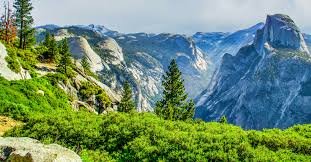
At the far end of the Valley looms Half Dome, perhaps the most iconic rock formation in the United States. Its sheer face looks as if the mountain was sliced perfectly in half by a giant blade. Hiking to the summit of Half Dome is a grueling 14-to-16-mile round trip that culminates in a terrifying, final ascent up a steep, smooth granite face using a pair of steel cables. Due to its extreme popularity, access to the cables requires winning a highly competitive permit lottery.
Iconic Trails and Thundering Waterfalls
Yosemite is synonymous with waterfalls, which are fueled entirely by the melting snowpack of the high Sierra. Yosemite Falls, the tallest waterfall in North America, drops a staggering 2,425 feet in three distinct tiers. The roar of the water echoing through the Valley during the peak spring runoff is deafening.
For those willing to endure a steep climb, the Mist Trail is widely considered the park’s signature hike. This strenuous route follows the Merced River upward, climbing steep, slippery stone staircases directly alongside Vernal and Nevada Falls. As the name implies, hikers are continuously drenched by the freezing, powerful spray of the waterfalls. Waterproof boots with aggressive grip are non-negotiable here, as the slick granite terrain is highly unforgiving.
Ancient Giants: The Mariposa Grove
Near the park’s south entrance lies the Mariposa Grove, home to over 500 mature Giant Sequoias. These ancient, massive trees—some of which are over 2,000 years old—are among the largest living organisms on the planet. Walking among these silent, towering sentinels offers a humbling perspective on time and scale, providing a distinctly different natural experience from the dramatic rock formations of the Valley.
The High Country: Tuolumne Meadows
To escape the heat and congestion of the Valley floor, seasoned travelers take the winding Tioga Road up to Tuolumne Meadows. Sitting at an elevation of 8,600 feet, this sub-alpine wonderland features sprawling green meadows dotted with crystalline lakes and surrounded by smooth granite domes. The air is thinner and cooler up here, and the crowds are significantly smaller. It serves as the primary jumping-off point for multi-day backpacking trips into the remote Yosemite backcountry, where encounters with black bears, marmots, and complete isolation are the norm.
Navigating the Park in 2026: The Post-Reservation Era
Visiting Yosemite requires strategic planning. In 2026, the National Park Service removed the timed-entry vehicle reservation system that had been in place during previous peak seasons. While this removed the barrier of entry, it has fundamentally shifted the challenge back to extreme traffic and parking scarcity.
Drive-up access means unmanaged summer surges have returned. On weekends and holidays, the finite parking lots in Yosemite Valley are frequently completely full by 7:30 AM, resulting in gridlocked traffic and hours-long waits at the entrance gates. To mitigate delays, visitors are urged to purchase their digital entry passes online in advance via Recreation.gov. Once inside the park, utilizing public transit options, such as the regional YARTS buses or the free Valley Shuttle system, is essential to navigating the park without losing a hard-won parking space.