
Introduction
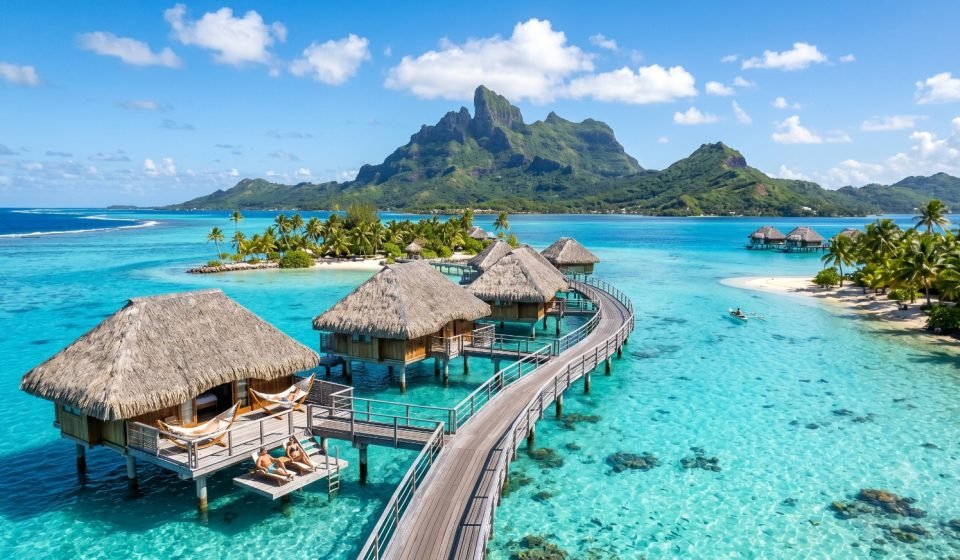
Rising from the translucent waters of the Society Islands in French Polynesia, Bora Bora is an island that feels almost mythical in its beauty. For decades, it has stood as the global archetype of tropical luxury, a destination synonymous with honeymoon romance, pristine overwater bungalows, and a lagoon that defies belief with its shades of cerulean, turquoise, and aquamarine. Yet, beneath its well-polished veneer of high-end tourism lies a fascinating geological history and a resilient Tahitian culture that grounds this paradise in reality. Born from a volcanic eruption millions of years ago, the island is now a perfectly formed atoll, consisting of a central mountain mass surrounded by a protective barrier reef and a string of low-lying islets known as motus.
The Geography of a Lagoon
To understand Bora Bora, one must understand its unique layout. The main island is dominated by the jagged, basalt remnants of an extinct volcano: Mount Otemanu and Mount Pahia. Mount Otemanu, rising 727 meters above sea level, serves as the island’s dramatic anchor, its sheer black rock faces contrasting sharply with the lush green vegetation clinging to its base.
Surrounding this volcanic core is the legendary lagoon, which is roughly three times the size of the landmass itself. Because the lagoon is protected by an outer coral reef, its waters remain calm, shallow, and incredibly warm. The outer motus are where most of the luxury international resorts are located, positioned deliberately to offer guests uninterrupted views across the water toward the dramatic peaks of the main island.
The Overwater Bungalow Experience
Bora Bora did not invent the overwater bungalow—that distinction belongs to the neighboring island of Raiatea—but it certainly perfected it. These architectural marvels allow travelers to live directly above the marine ecosystem. Designed with traditional Polynesian aesthetics in mind—featuring thatched roofs, local hardwoods, and woven accents—modern bungalows offer unparalleled luxury.
Many feature glass floor panels, colloquially called “Tahitian television,” which allow guests to watch colorful reef fish, stingrays, and occasional blacktip reef sharks swim beneath their feet. The experience is designed for ultimate privacy and isolation, with private plunge pools, direct lagoon access via ladders, and room service delivered via traditional outrigger canoes.
Adventure Beyond the Resort
While it is tempting to spend an entire vacation lounging on a private deck, Bora Bora’s natural environment begs exploration. The lagoon is a sanctuary for marine life. Snorkeling and diving excursions are the most popular activities, taking visitors to famous sites like the “Coral Gardens” or the “Anau” dive site, where massive manta rays glide gracefully through the water. For the more adventurous, guided lagoon tours offer the opportunity to wade into chest-deep water to feed and interact with habituated stingrays and blacktip reef sharks under the supervision of local guides.
On the main island, inland adventures offer a change of pace. Because the interior is mountainous and covered in dense jungle, exploring requires a four-wheel-drive vehicle or a guided hiking tour. Travelers can explore old World War II sites, where the United States military set up a supply base after the attack on Pearl Harbor. Seven massive coastal defense guns, left behind by American troops, still sit silently on the hillsides, slowly being reclaimed by the jungle but offering panoramic views of the ocean.
Culture and the Town of Vaitape
The cultural and commercial heart of the island is Vaitape, a small, bustling waterfront town on the western coast. While it lacks the manicured perfection of the resorts, Vaitape provides a window into the daily lives of the island’s roughly 10,000 residents. Here, visitors can browse local markets filled with brightly colored sarongs (pareos), handcrafted wood carvings, and the region’s famous black pearls, which are cultivated in the pristine waters of the Tuamotu and Gambier archipelagos.
Dining in Bora Bora ranges from high-end French-Polynesian fusion cuisine at resort restaurants to casual roadside eateries called roulottes (food trucks) in Vaitape, where locals and tourists alike gather to eat poisson cru—a refreshing dish of raw tuna marinated in lime juice and fresh coconut milk.
Practical Travel Details
- Best Time to Visit: The dry season runs from May to October, offering cooler temperatures, lower humidity, and minimal rainfall. The wet season (November to April) is hotter and more humid, with a higher chance of tropical storms, though it offers lower prices and fewer crowds.
- Getting Around: Visitors arrive at Bora Bora Airport (BOB), located on a separate motu. From there, transport to resorts is entirely by boat. On the main island, bicycles, scooters, and small rental cars are available, though many visitors rely on hotel shuttles or local taxis.